Latest Info on Eritrea gov spend, Public Purchasing, Govt budget & Public spending
- Home >
- Public Procurement
Public Procurement in Eritrea
Public procurement in Eritrea plays a critical role in supporting government administration, public service delivery, and national development activities. Government purchasing is primarily directed toward meeting essential public needs, maintaining infrastructure, and supporting state-led economic activities within a highly centralized governance structure.
The procurement environment in Eritrea is characterized by limited formalization and strong administrative control. Public procurement activities are conducted through ministries and public institutions under general legal and administrative provisions rather than a single, comprehensive procurement statute or centralized electronic system.
For domestic suppliers and international firms, Public Procurement in Eritrea represents a tightly controlled and institution-driven market. Participation in government tenders in Eritrea requires close familiarity with administrative procedures, contractual requirements, and engagement with relevant public authorities.
Country & Economic Overview
| Country | Eritrea |
| Region | Sub-Saharan Africa |
| Population | 3,620,312 (2022) |
| Income Level | Low-income economy |
| Currency | Nakfa (ERN) |
| Exchange Environment | Managed exchange regime |
| GDP | USD 2,065,001,626 (2022) |
| GNI | USD 2,356,121,868 (2022) |
| GNI per Capita | USD 610 (2022) |
The limited size of the economy and the dominant role of the public sector mean that public procurement remains one of the principal channels for organized contracting activity in Eritrea.
Public Procurement Governance Framework
Eritrea does not operate a formally designated public procurement authority comparable to those found in many other countries. Instead, procurement governance is exercised through ministerial structures and administrative oversight mechanisms.
| Public Procurement Agency (PPA) | Not formally designated |
| Procurement Oversight | Relevant line ministries and central government authorities |
| Central Purchasing Body | Central purchasing arrangements not formally established |
| Contract Registration | Administrative contract registration practices |
Each ministry or public institution is responsible for managing its own procurement activities within the bounds of applicable administrative and legal requirements.
Legal & Regulatory Framework
Public procurement law in Eritrea is not consolidated into a single, modern procurement statute. Instead, procurement-related provisions are contained within broader legal instruments, including the Civil Code and sector-specific regulations.
- Public contracts governed under relevant sections of the Civil Code
- Administrative rules applied by public institutions
- Sectoral practices for procurement of works, goods, and services
Core procurement principles such as competition, administrative control, and contractual compliance are addressed through general legal provisions rather than procurement-specific legislation.
Procurement Procedures & Thresholds
Procurement procedures in Eritrea are largely determined by administrative practice rather than standardized national thresholds or codified procurement methods.
| Procedure Type | General Application |
| Competitive Tendering | Used selectively based on institutional decision |
| Direct Contracting | Applied through administrative authorization |
| Contract Registration | Required as part of administrative control |
Procedural elements such as advertisement timelines, bid validity periods, standstill periods, and complaint resolution timelines are not formally standardized across the public sector.
E-Procurement System Overview
Eritrea does not operate a national electronic procurement platform. Public procurement processes are conducted through manual and paper-based systems managed by individual contracting authorities.
| eProcurement System | No national system in operation |
| Electronic Tendering | Not implemented |
| World Bank eProcurement Usage | No |
The absence of an eProcurement system in Eritrea limits public access to procurement information and requires direct engagement with contracting authorities.
Procurement Market Ch4aracteristics
The procurement market in Eritrea is modest in scale and closely aligned with public sector priorities.
- Goods procurement focused on basic supplies and public services
- Works contracts related to infrastructure maintenance and construction
- Services procurement covering operational and technical needs
Domestic participation dominates procurement activity, with limited international involvement primarily through donor-supported or specialized projects.
Transparency, Complaints & Oversight
Oversight of public procurement in Eritrea is exercised through administrative supervision rather than independent review bodies.
- Internal administrative review of procurement decisions
- Contract registration and record-keeping requirements
- Limited public disclosure of procurement statistics
Formal complaint mechanisms and publicly available procurement reports are not a prominent feature of the system.
Sustainability & Green Public Procurement
Sustainability and green public procurement policies are not formally articulated within Eritrea’s procurement framework. Environmental considerations may be addressed indirectly through project planning and sectoral regulations.
Future developments in this area would depend on broader policy and institutional reforms.
Social & Ethical Procurement Considerations
Social and ethical considerations in procurement are addressed through general legal and administrative requirements rather than targeted procurement programs.
- No formal procurement provisions specific to women-owned businesses
- No dedicated mechanisms for disadvantaged groups
- Compliance with national labor and administrative laws
Ethical conduct is typically enforced through contractual obligations rather than procurement-specific policies.
Key Challenges & Practical Insights for Bidders
Bidders interested in Public Procurement in Eritrea should carefully consider the following practical factors:
- Limited formalization and documentation of procurement procedures
- Absence of electronic procurement tools
- Strong reliance on administrative decision-making
Successful participation often depends on close coordination with contracting authorities, use of local representation, and strict adherence to administrative and contractual requirements.
Public Procurement in Eritrea represents a highly centralized and administratively driven market. While opportunities exist, especially in essential goods and infrastructure-related projects, bidders must be prepared to operate within a constrained and evolving procurement environment.
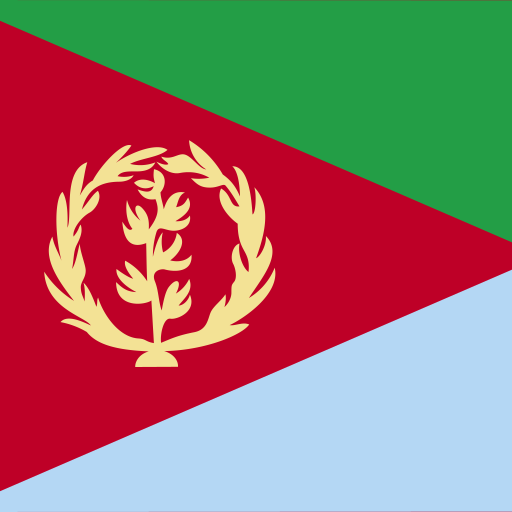
Flag of Eritrea

Emblem of Eritrea
Capital
Asmara
ISO 3166 Code
ER
Population
6,738,000
Area, Sq KM
121,320
Currency
Tallero
GDP, Billion USD
3,092
Language
Tigrinya, Arabic, English
GDP Growth Rate, %
2.0
Inflation, Avg CP, %
NA
Interest Rates, %
-
Unemployement Rate, %
-
Exchange Rate, 1 USD Equals
15.28
International dial code
291
Time ZONE
GMT+03:00
Internet TLD
.er
Get FREE SAMPLE TENDERS from Eritrea in your email inbox.
Copyright © 2014-2026 EritreaTenders.com. All Rights Reserved.